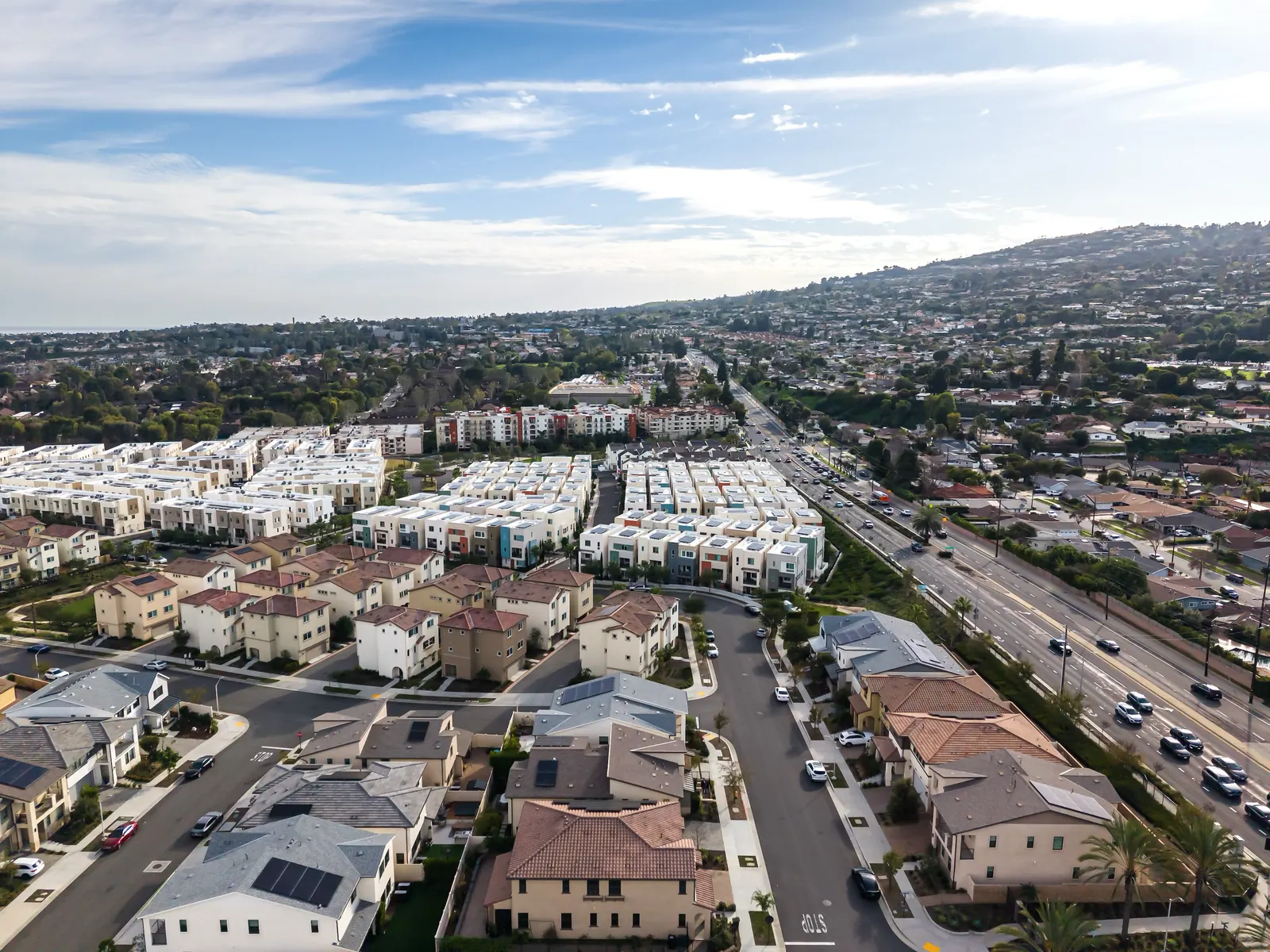
Ponte Vista is the second neighborhood built on this hillside. The first was a community of 245 Navy family residences that stood here from the 1960s through the 1990s. When the Navy families left, the property entered a transition that would last more than twenty years before construction began on the first Ponte Vista model homes.
During that time, the former housing passed out of federal ownership, an initial plan for 2,300 homes was reduced again and again through years of review, and the hillside was rebuilt for new streets, utilities and homes. That long sequence explains the scale and mix of home collections found at Ponte Vista today.
-
1962 to 1964Navy family housing is built
245 homes in 123 buildings.
-
1994 to 1999The naval drawdown closes the neighborhood
1995 BRAC selection, 1997 shipyard closure, housing closed by 1999.
-
2,3002005The first private proposal
Original proposal for 2,300 homes.
-
2014A much smaller plan is approved
676-unit tract configuration within a legal ceiling of up to 700 homes, plus a 2.42-acre park.
-
2014 to 2020Demolition and site reconstruction
Grading, drainage, buried utilities, roads and Western Avenue work.
-
2020 to 2026The new community is built in phases
First models in 2020; RC Homes announced the final phase of The Heights in June 2026.
The first neighborhood on the hillside
The Navy housing was built between 1962 and 1964. Its 122 single-story duplexes and one detached house provided 245 family residences, many with garages, small lawns, fenced backyards and patios.1 John Montgomery Drive, which is now known as Horizon Way, formed the main curving loop through the old neighborhood.
The housing was built for junior officers, senior enlisted personnel and their families assigned to the Long Beach naval complex. Army and Coast Guard families were also living there by the 1990s. Los Angeles historic research places the Western Avenue neighborhood within San Pedro's broader postwar Filipino American military history, identifying it as one of the places available to Filipino military families as that community grew.2
The neighborhood included a community center, a small convenience store, playground space and a basketball court. The center, store and playground were still serving residents in 1996, more than three decades after the first families arrived.1
The naval closures brought the neighborhood to an end
The Long Beach Naval Station closed in 1994. In 1995, the federal government decided to close the Long Beach Naval Shipyard and the San Pedro housing as well. The change was gradual: more than two thirds of the Western Avenue homes were still occupied in August 1996, residents continued moving out during 1997, and the housing was vacant by the end of the decade.3
The Navy declared the property surplus in July 1997, beginning a lengthy federal reuse process. It fell to the City of Los Angeles to prepare a reuse plan that balanced redevelopment with claims from public agencies and eligible organizations serving homeless people. HUD rejected the city's first plan in 2003 after a dispute over housing for homeless and low-income uses. After that issue was resolved, the roughly 61.5-acre Western Avenue site became available for private redevelopment in 2005.3
The first private development proposal arrived that same year.
The plan that had to shrink
The 2005 proposal called for 2,300 homes, with buildings four to six stories tall, senior housing, retail space and a park. It would have placed more than nine times the old neighborhood's number of homes on the property.
Opposition centered on the density, building heights and projected traffic on Western Avenue. The property is inside Los Angeles, directly across the street from Rancho Palos Verdes neighborhoods, so officials and residents there followed the review closely. Even after the plan was reduced to 1,950 homes, the Los Angeles City Planning Commission rejected it in April 2009 and directed the developer to return with a much smaller project.
A second planning process followed. The version presented at the final City Planning Commission stage in 2013 contained 676 homes. On March 4, 2014, the Los Angeles City Council approved a Specific Plan capped at 700 homes and including a 2.42-acre public park. Nine years after the original proposal, the approved maximum was less than one third of the starting count.4
The approval set the project's overall framework and 700-home ceiling. It did not make the former Navy property ready for homes; subdivision maps and years of site preparation were still required.
Rebuilding the hillside
Demolition began in May 2014, and most of the Navy buildings came down during 2015. Environmental review had identified asbestos-containing material and lead-based paint in portions of the old structures and required regulated removal as part of demolition.
The property drops roughly 150 feet across the hillside, and the earlier Navy development had left layers of soil that were not documented or compacted to modern building standards. Contractors had to remove or recompact unsuitable soil, reshape the grades and create level building areas strong enough to support new streets and homes.
The approved plan also required moving the open drainage channel underground, along with a new flood-control plan, new water and sewer systems, underground utilities, streets and emergency access. Later project records document that common infrastructure work and improvements along Western Avenue, including signals and turn lanes near the community entrances.5
That site preparation and shared infrastructure work went on for years after the plan was approved.
Harridge Development Group acquired the project in early 2018. As master developer, it continued building the streets, sewers, storm drains and rough building pads that would serve the whole site. Los Angeles approved the first final subdivision map in December 2019, almost six years after the Specific Plan. Construction of the first model homes followed in 2020.6
Ponte Vista took shape one section at a time
The approved plan divided the property into six areas for housing and a seventh for recreation and shared open space. Harridge prepared the common streets, utilities and building areas before individual sections went to homebuilders.
D.R. Horton was first, with construction of The Estates model homes underway in 2020. KB Home opened Skyview and Westport in 2021. Taylor Morrison, Meritage Homes and RC Homes followed in other residential sections, while Suncrest became the rental neighborhood.
Within that framework, the individual builders gave each section its own architecture and floor plans. Construction continued in stages over several years instead of producing one finished neighborhood at once. RC Homes announced the final phase of The Heights in June 2026, six years after construction began on the first models.6
What the history explains today
The community's current form reflects each part of that history. Its approved scale came from the long debate that reduced the original 2,300-home proposal. Its streets and building areas required years of grading and infrastructure work. Its distinct collections came from several builders working within separate parts of one approved plan.
More than twenty years after the Navy families left, homes returned to a hillside that had already been a San Pedro neighborhood for a generation. Ponte Vista is the second neighborhood built here, shaped by the long process of deciding what should replace the first and preparing the land to support it.
Sources
- Ponte Vista Historic Resources Report; 1997 Federal Register notice for San Pedro Navy housing. ↩
- Los Angeles Times, July 4, 1991; 1996 Navy Environmental Baseline Survey; Los Angeles Citywide Historic Context Statement: Filipino Americans in Los Angeles, 1903 to 1980. ↩
- Navy BRAC history of the former Long Beach Naval Complex; 1997 Federal Register surplus notice; Rancho Palos Verdes Border Issues Status Report, December 21, 2021. ↩
- Los Angeles City Planning, original Ponte Vista Draft EIR; Los Angeles Times, April 10, 2009; Los Angeles Ordinance No. 182939. ↩
- Los Angeles Draft EIR, Hazardous Materials; Los Angeles Regional Water Quality Control Board certification; 2011 Preliminary Geotechnical Report; Rancho Palos Verdes Border Issues Status Report, December 21, 2021. ↩
- Rancho Palos Verdes, May 2018 project-transition report; Los Angeles Bureau of Engineering final-map report, November 26, 2019; Rancho Palos Verdes, December 2025 Border Issues Status Report; RC Homes final-phase announcement, June 24, 2026; Suncrest at Ponte Vista. ↩